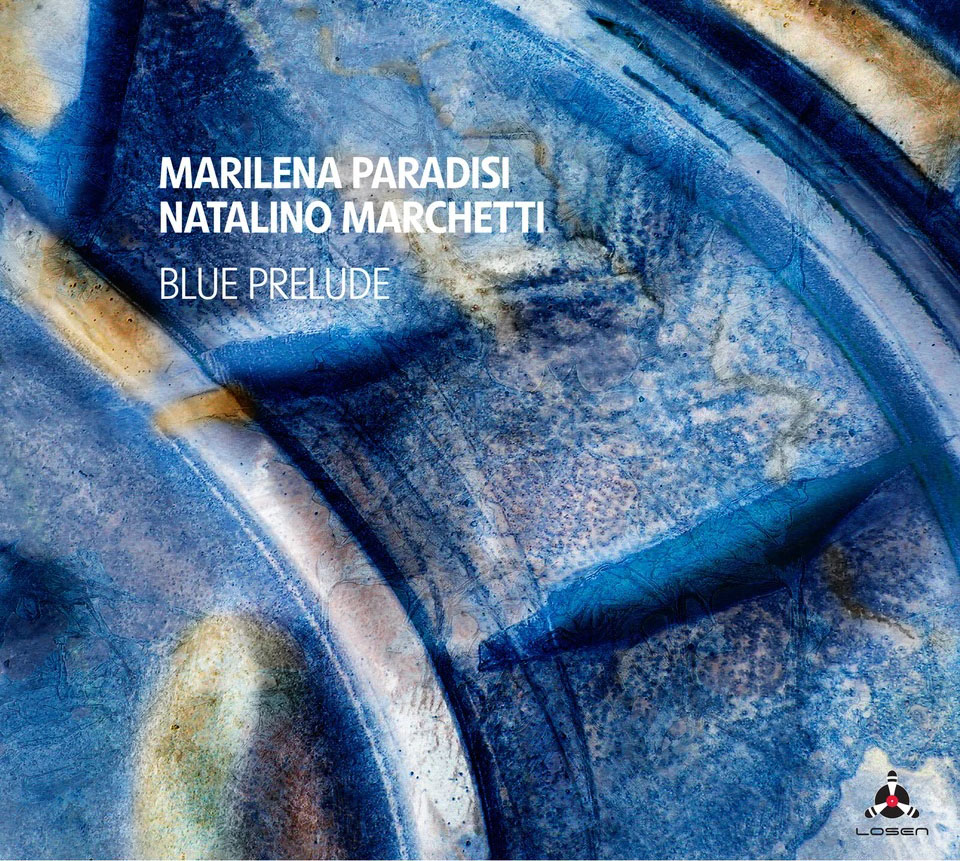
“Blue Prelude”: Marilena Paradisi and Natalino Marchetti: The Voice, the Bellows, and the Art of Variation (Losen Records, 2026)
Their encounter produces a form of jazz chamber music in which complexity remains at the service of the listening experience and virtuosity, when it appears, never claims attention for itself. What remains are the modulations, the silences, the metric deviations, the melodic memories, and that particular freedom that only a genuinely peer-to-peer dialogue can render credible.
// di Francesco Cataldo Verrina //
With «Blue Prelude», Marilena Paradisi and Natalino Marchetti commit to an encounter in which voice and accordion cease to inhabit two separate instrumental realms, converging instead in the unified elaboration of the sonic material. The vocalist, now at her tenth album and her third release with Losen Records, brings to the project an inquiry honed in the field of contemporary improvisation, while Marchetti subjects his instrument to a continuous acoustic metamorphosis, fully exploiting its range, dynamics, and polyphonic nature. The result is a chamber dialogue in which the absence of other instruments in no way impoverishes the material, as the accordion's potential is expanded to suggest disparate registers—from low frequencies reminiscent of the bass clarinet to string-like textures, through to rhythmic articulations generated by the very mechanics of the accordion.
The title «Blue Prelude» already contains an interpretative key. The «blue» does not merely reference the African American tradition, but suggests an expressive condition in which melancholy, memory, and yearning coexist with the improvisational freedom inherent to jazz. The «prelude», conversely, evokes an open form, predisposed to variation and the thematic suspension of material. Paradisi and Marchetti operate precisely within this interstitial space, where a familiar repertoire is treated not as a relic, but as material open to novel melodic, metric, and harmonic inflections. The selection of the nine compositions decisively shapes the album's profile. Jim Van Heusen, Burton Lane, Dizzy Gillespie, Wayne Shorter, Pat Metheny, Gordon Jenkins, Stephen Sondheim, Antônio Carlos Jobim, and Horace Silver belong to disparate compositional universes, yet are unified by a melodic penmanship sufficiently distinct to sustain even radical re-readings. Paradisi and Marchetti do not strive for an artificial homogeneity across repertoires distant in era and idiom. Rather, cohesion emerges from a shared interpretative stance, grounded in reciprocal listening and the ability to expand upon themes without compromising their recognizability. «Here’s That Rainy Day» immediately ushers the duo into an oblique dimension. The celebrated ballad takes on tango-esque inflections, with a rhythmic phrasing that reshapes temporal perception and imbues the melody with a South American melancholy. Paradisi approaches the theme not as a fixed sequence to be slavishly observed, but as an elastic line subject to subtle variations of accentuation, phraseological expansions, and contractions. Marchetti responds with an accompaniment that eschews a purely harmonic-rhythmic function, contributing directly to the definition of the acoustic environment. «On a Clear Day» undertakes a further metric shift. Abandoning the traditional four-four time in favor of three-four radically alters the piece's kinetic perception, endowing it with the momentum of a rapid waltz. This choice impacts the relationship between melodic phrase and pulse, compelling the vocalist to redefine accents and points of arrival. Marchetti harnesses the pulsating nature of the bellows to make the metric movement palpable without stiffening it into a mechanical beat. Wayne Shorter's «Ana Maria» leads the duo into harmonically more arduous territory. Shorter’s writing—predicated on chordal and melodic relationships that routinely elude the predictability of functional progressions—could easily subject the interpreter to the hazard of an overly cerebral reading. Paradisi, however, advances with an effortless grace that renders the complexity tangible without ostentation. Vocal inflections follow the contours of the phrase, while Marchetti distributes the chordal components with an almost orchestral sensitivity. The technical difficulty thus remains subsumed within the performance, rather than becoming the focal point of the performance itself.
«I Waited for You» offers one of the moments in which inventive impulse achieves the greatest freedom. The introduction departs from the conventional ballad framework, preparing the vocalist's entrance into a domain already subject to an altered temporal perspective. Improvisation does not function as a virtuosic interlude positioned between exposition and reprise; rather, it permeates the very fabric of the melody. Paradisi possesses an instrumental diction in which consonants, vowels, attacks, and releases participate in shaping the phrase as much as defined pitches. Marchetti responds with a remarkably broad palette, alternating chords, inner voices, and percussive gestures. Pat Metheny’s «Always and Forever» carries this freedom toward an even more narrative dimension. Paradisi addresses the instrumental theme by setting an Italian lyric to it—a choice that reconfigures the original relationship between word and melody without diminishing the piece's profile. The singer does not merely verbalize an existing line, but seeks within it a new semantic potential, aligning prosody and phrasing. The word thus enters the melodic fabric as a compositional element, with a natural cadence that prevents the translation from feeling superimposed upon the music. Jobim's «Luiza» reaffirms Paradisi's distinct affinity for writing in which melody and harmony interact through nuanced relationships. The translation of the Brazilian text preserves an intimacy bound to the phrasing, while the accordion illuminates those modulations and chordal inflections native to the grammar of Brazilian song without reducing them to mere stylistic quotation. The voice maintains a controlled suppleness, allowing subtle dynamic shifts to define the interpretative character. «Blue Prelude», composed by Joe Bishop and Gordon Jenkins, assumes a central position conceptually as well. Here, the blues reference emerges as an expressive foundation rather than an overt formal scheme. Vocal color, the pacing of pauses, and the fluid agility of the instrument converge in an interpretation wherein the piece's inherent sense of longing assumes an almost cinematic quality. The album's title thus finds its musical justification, unencumbered by programmatic overlays. In Stephen Sondheim's «I Remember», memory becomes sonic matter. Paradisi progressively pares back emphasis, allowing the vocal delivery to unfold with an almost conversational intimacy, while Marchetti strips weight from the instrument's resonance. The outcome possesses an elegiac quality born of restraint rather than sentimental fervor. The accordion, emancipated from any subordinate role, traces the path of the voice with chords and resonances that yield to silence. The concluding effect acquires a formal as well as an emotional weight, as the reduction of acoustic matter prepares a heightened perception of time. Bringing the repertoire to a close is Horace Silver's «St. Vitus Dance», marked by its rhythmic vitality and unmistakable character. Its brief duration—barely exceeding two minutes—concentrates the performance into a taut, sparkling synthesis, as if to restore momentum following the introspective depths of «I Remember». This contrast brings greater sharpness to the overarching design of the album, in which the succession of tracks does not follow a simplistic alternation of moods, but traces a perceptive arc grounded in metric shifts, differing densities, and evolving variations in the relationship between text, melody, and accompaniment.
The most significant achievement of «Blue Prelude» therefore concerns the very nature of the dialogue between Paradisi and Marchetti. The accordion does not serve a subordinate role to the voice, nor does the voice treat the instrument as mere harmonic support. Both participants engage in a chamber music framework where each gesture reframes the perception of the other. The accordion may assume the role of bass, counter-melody, chordal foundation, or percussive texture; the vocalist may trace a thematic line, fracture into improvisational inflections, sustain a syllable, alter an accent, or temporarily suspend the recognizability of the theme. Their encounter produces a form of jazz chamber music in which complexity remains at the service of the listening experience and virtuosity, when it appears, never claims attention for itself. What remains are the modulations, the silences, the metric deviations, the melodic memories, and that particular freedom that only a genuinely peer-to-peer dialogue can render credible.